By Ahmad Rafi Civic Tech Researcher, Insights Bangladesh |NagorikBD| Talk_First civic tech community PlatfromEconomic Advisor & Policy Analyst
The rhetoric surrounding Bangladesh’s economic trajectory has, for the last decade, been one of “developmental exceptionalism.” We point to the shimmering skyline of Dhaka, the structural triumph of the Padma Bridge, and a GDP that has crossed the $450 billion mark. Yet, as an economic adviser peering behind the curtain of national accounts, I find the celebratory narrative increasingly decoupled from a haunting statistical reality.
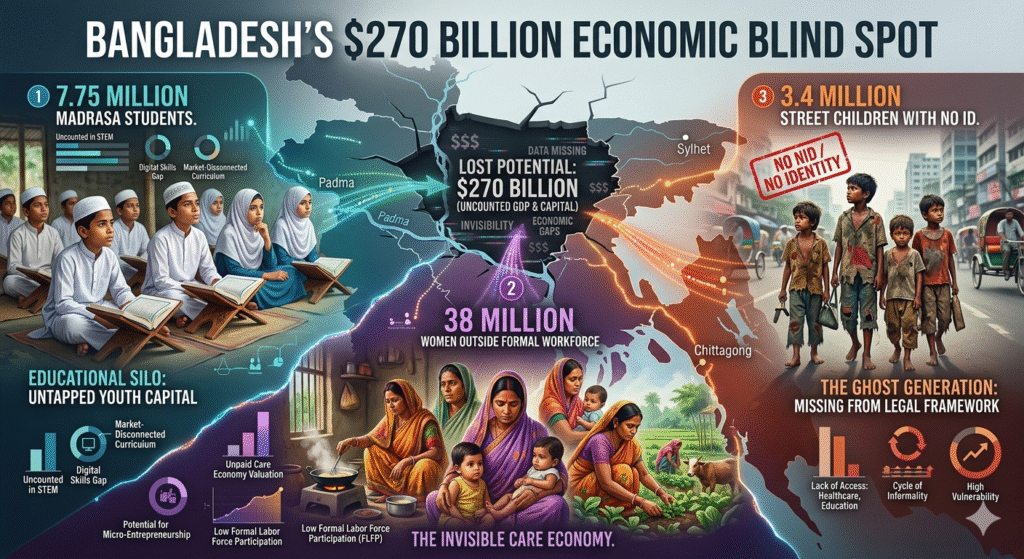
In Bangladesh, our data architecture is not merely flawed; it is exclusionary. There exists a massive, untapped human capital reservoir—a $270 billion “Blind Spot”—comprising three distinct demographics that the state has failed to formally quantify, integrate, or empower. These are the 7.75 million Madrasa students, the 38 million women outside the formal workforce, and the 3.4 million street children living without legal identities.
If we are to transition from a “Middle-Income” nation to a “Developed” one, we must stop treating these 49 million human beings as statistical ghosts.
1. The Educational Silo: 7.75 Million Madrasa Students
The first pillar of our blind spot is the Madrasa education system, specifically the Qawmi sector. Current estimates suggest approximately 7.75 million students are enrolled in various Madrasa tiers across the country.
The Economic Disconnect
For decades, the state has viewed Madrasas through a lens of security or religious oversight rather than economic potential. This is a catastrophic fiscal error. By failing to standardize the curriculum with market-driven skills—such as ICT, technical vocational training, and functional English—we are essentially graduating millions of youth into an “economic vacuum.”
- Human Capital Waste: When 7.75 million minds are excluded from the STEM and digital economy pipelines, the national productivity ceiling drops significantly.
- The Literacy Myth: While these students are literate in Arabic or Persian, their “Economic Literacy”—the ability to navigate modern financial systems or global job markets—remains unmeasured and unsupported.
The Policy Pivot: We must move beyond “recognition” of degrees and toward “functional integration.” If even 20% of this group were equipped with freelance-ready digital skills, the infusion into the national remittance and service sector would be worth billions.
2. The Invisible Engine: 3.8 Crore Women Outside the Workforce
Perhaps the most glaring hole in our GDP calculation is the 3.8 crore (38 million) women who are classified as “not in the labor force.”
The Care Economy vs. The Cash Economy
In Bangladesh, the “Female Labor Force Participation” (FLFP) rate hovers around 36-38%, which is significantly lower than peer nations like Vietnam. The remaining 38 million women are not “unproductive”; they are the backbone of the Unpaid Care Economy. They manage households, raise the next generation of laborers, and sustain rural subsistence.
- The $200 Billion Valuation: If the domestic work performed by these 38 million women were valued at even the minimum wage, it would add an estimated $200 billion to the nominal GDP.
- The Structural Barriers: Why aren’t they in the formal data? Because our urban planning lacks childcare infrastructure, our transport is unsafe, and our digital economy still has a massive gender divide.
The Economic Imperative: To ignore 38 million potential workers is to run an engine on half its cylinders. Transitioning just 10% of these women into micro-entrepreneurship or the formal gig economy would catalyze a consumer spending boom that could shield Bangladesh from global recessionary shocks.
3. The Ghost Generation: 3.4 Million Street Children
The most heartbreaking, and arguably most dangerous, data omission is the plight of our street children. Estimates from various NGOs and the Bangladesh Institute of Development Studies (BIDS) suggest there are roughly 3.4 million children living on the streets, many of whom lack a birth certificate or a National ID (NID).
Life Without a Footprint
In a modern economy, if you don’t have an ID, you don’t exist. You cannot open a bank account, you cannot enroll in a formal school, and you cannot access state healthcare.
- The Cycle of Informality: These children grow up into the informal “shadow economy.” They become waste pickers, day laborers, or worse, are recruited into criminal syndicates.
- The Long-term Fiscal Burden: By failing to count and invest in these 3.4 million children today, the state is guaranteeing a future burden on the healthcare and justice systems. We are essentially “importing” poverty into the future.
The Solution: A radical “Identity First” policy. The government must decouple the issuance of birth registration from permanent address requirements, allowing these children to enter the state’s social safety net.
The Macro-Economic Consequences of Data Exclusion
As an economic adviser, I argue that this “Blind Spot” isn’t just a social justice issue—it is a sovereignty and stability issue. ### 1. Inaccurate Inflation & Consumption Models
When the Bangladesh Bureau of Statistics (BBS) calculates the Consumer Price Index (CPI) or poverty headcounts, how accurate can they be if they ignore the consumption patterns of nearly 50 million people? We are making national interest rate decisions and fiscal policies based on a partial map.
2. The “K-Shaped” Recovery
Our GDP growth is currently “K-shaped.” The top 10% are seeing exponential wealth growth, while the 49 million people in these three “uncounted” groups are stagnant or backsliding. This disparity creates social friction that can destabilize the very environment needed for Foreign Direct Investment (FDI).
3. The Missed Digital Dividend
Bangladesh talks about “Smart Bangladesh 2041.” However, a country cannot be “smart” if 7.75 million students are offline and 3.4 million children are without IDs. The digital divide is widening, and the “Blind Spot” is where the most vulnerable fall through the cracks.
A Call to Action: The Insights Bangladesh Roadmap
At the Insights Bangladesh Research Institute, we propose a three-tiered “Inclusion Protocol” to reclaim this $270 billion potential:
I. The “Great Census” of the Informal
We need a specialized, tech-driven census that goes beyond households. We need to map the “floating” populations and the “hidden” household workers. Using blockchain-based digital IDs could provide a secure way to give the 3.4 million street children a legal footprint without the bureaucratic hurdles of traditional residency.
II. Skill-Bridge Initiatives for Madrasas
The Ministry of Education, in collaboration with the private sector, should launch “Skill-Bridge” centers inside Madrasas. This is not about changing religious education; it is about adding an economic layer to it. Teaching a Madrasa student Python or Graphic Design is the fastest way to alleviate rural poverty.
III. Monetizing the Care Economy
The government should introduce “Care Credits” or tax incentives for households where women are engaged in informal care, alongside massive investment in community-based daycare. Bringing 38 million women into the financial system via Mobile Financial Services (MFS) like bKash or Nagad is the first step toward formalization.
Conclusion: Beyond the Numbers
Bangladesh stands at a crossroads. We can continue to tout a GDP figure that looks good on a PowerPoint presentation in Washington or London, or we can do the hard work of counting the people who actually build this nation.
The $270 billion lost in our blind spot is not just a number—it represents the dreams of a Madrasa student who wants to be a coder, the ambition of a mother who wants to start a boutique, and the right of a child on the street to simply be recognized as a citizen.
As an economic adviser, my message to the policymakers is simple: You cannot manage what you do not measure. It is time to turn the lights on. It is time to count everyone. Only then will the “Bangladesh Miracle” be a reality for all 170 million of us, rather than a privilege for the few.
Ahmad Rafi is a Senior Researcher at Insights Bangladesh Research Institute. His work focuses on macro-economic policy, informal labor markets, and the socio-economic integration of marginalized demographics in South Asia.